
“If you hold anything dear outside of your own reasoned choice, you will have destroyed your capacity for choice.” — Epictetus
So you’ve hit a dip, or rock bottom.
There was a misunderstanding with your manager. Little dip. Your product test flopped. Moderate Dip. Your personal life is problematic. Mega dip.
Wherever you are in life, we all go through ebbs and flows. Reinvention exacerbates these peaks and troughs adding further complexity.
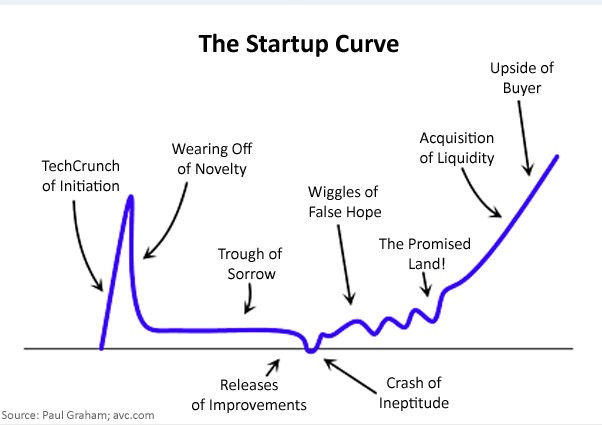
In an earlier post on happiness hacks, I introduced Paul Graham’s ‘trough of sorrow’.
Most popularised in The Start-Up Curve, the trough of sorrow features as per below:
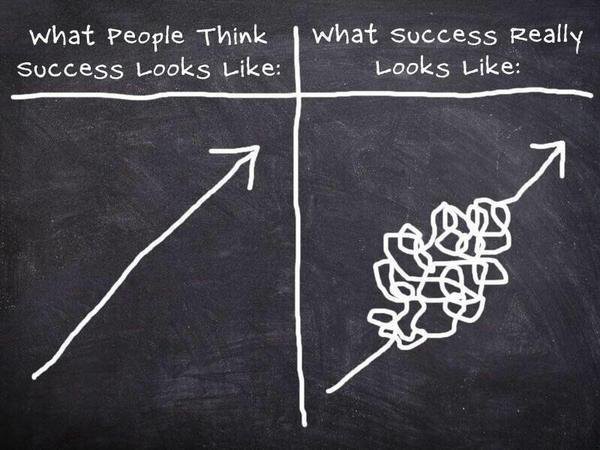
Here is also a good representation of what you think vs what actually happens in success:

This week was a big week for me; both personally and professionally. It was a double-whammy hit in the trough trenches. As I began writing this next post, I thought:
How can I combat and even out the troughs of sorrow?
1. Analyse Pros & Cons:
Lists are good, what can I say?
Listing advantages and disadvantages of various outcomes, options, or solutions is a systematic method to help draw conclusions or make decisions.
Here you can measure, prioritise, and weigh both pros and cons.
Dependent on the size of each list, decisions can also be made upon comparing the relative opportunity cost of two or more choices.
While a level of intuition is valuable in decision making, our emotions often cloud different perspectives. Removing bias or overly emotional rationalisation from strategic decisions, allows for a more logical, scientific approach.
Better decisions lead to better chances of success. Therefore you are less likely to fall into a trough.
2. Plan to fail:
WAIT, WHAT? But doesn’t the saying go “If you fail to plan, you plan to fail”? Even with planning, sometimes you fail. Most likely so. Even the best planning leads to failure. Why?
Because you’re testing hypotheses. Because your product doesn’t align to your customer segment; yet. Or your plane gets stuck in bad weather when you’re due for your interstate job interview.
Some things are out of our control.
Setting the right expectations upfront gives you a mental buffer from failing into despair.
This doesn’t mean you become complacent, but rather, leaves room for opportunity and learning irrespective of whatever outcomes occur.
The Latin phrase “Amor Fati” means “A love of fate”— that is not just to just accept, but to love everything that happens.
Using failure as a mechanism to pivot or persevere, acts as a good set point to move away from what isn’t working. Channelling your failures into growth with the right mindset can prevail in overcoming low points of reinvention.

3. Make peace with your decisions
Failure sucks. Most of the time it’s conducive to quitting. Entrepreneur Seth Godin provides a different view, “Winners quit fast, quit often, and quit without guilt-until they commit to beating the right Dip for the right reasons”.
Based on your analysis of pros and cons, robust success metrics, and potential win-win outcomes, drawing a line in the sand and moving forth without regret will move you closer towards your goals.
Recognising that as much as you’d like to hold off in order to make complete informed decisions, we only know what we know at any point. Remember resistance feeds the impact of difficulty.
Allow the flow of things to take place as they should. Owning whatever outcome and your response to what's within the remit of your control (or what you can do), will alleviate your growth pains.
“Worry is like interest paid in advance on a debt that never comes due.” — The Spanish Prisoner

4. Build your runway
Your runway is any means; financial, social, emotional, physical that supports you through your reinvention.
For example, having a level of financial stability or comfort will significantly reduce the trough of despair. When we are faced challenges that have comparable life-or death consequences, our natural fear response gets triggered.
Reinvention is about making smart, strategic choices to launch off into new territories of opportunity, purpose, and fulfilment. Don’t suffer more than you have to in the process.
If you don’t have the luxury of launching off with a strong foundation, what skills do you have, or can you develop to form a side hustle while you reinvent?
How and can you leverage this side hustle as a platform to something else?

5. Have a sounding board — find your tribe
This last one is really important. What networks or support tribe do you have? Who are your advocates? Who do you learn from and with? Who do you bounce ideas, emotions, bad days off?
Numerous start-ups quote the benefits of having a cofounder. Sometimes it’s just sharing the load in order to avoid an out of control spiral of despair.
Celebrating success and small wins with others has power because when you're able to witness progress in meaningful work, you're likely to be more creative and successful in the long run.
My snapshot:
Unfortunately, I can’t share too much of my professional trough this week as I am still going through it. As I progress I will elaborate further.
I have analysed my different options and the costs — both positive and negative with each outcome.
My reinvention journey has been ongoing for some time, therefore, I didn’t have too strong emotions relating to what happened.
While I did have an element of uncertain anxiety, I reminded myself that I should truly seek the most I could out of this opportunity and what could I control?
Sometimes our personal lives are much harder, but the same 5 tips above can be used in any context.
Rehash:
- Troughs of sorrow are sometimes unavoidable. When faced with one (or many), what analysis can you do based on what you know of the positives and negatives?
- Set strong expectations that you may fail or things may not work out. What can you do to fuel this fail into success?
- Are you a decisive person? Are there measures can you put in place to objectively make decisions and stick to them?
- Do you have a solid platform to reinvent? If not what things can you do to build a runway?
- Who around you is a support network? How can you leverage those around you better to boost your reinvention?


