
As a recent owner of Sapiens and Homo Deus, I was excited to see Yuval Noah Harari’s latest book — 21 Lessons for the 21st Century recently at the airport. The book covers an array of topics, from education to technology, to philosophies on life. As I flicked through its pages, it surprised me that despite the abundance of information at our fingertips, one area of life still remains enigmatic in the modern age; love.
Love is an esoteric concept that has had thousands of songs, poems, plays, movies, books, and philosophies produced about it — trying to decode its meaning and purpose. It is the most discussed, agonised, and analysed of all topics throughout the thousands of years of our existence. Taking inspiration from Harai, here are 21 contemporary love lessons on one of the most remarkable and worthwhile human experiences.
1. Love is the one place for | absolutes |
In a world where absolutes can be dangerous, clear boundaries should be defined with both romantic and platonic love. Boundaries exist to create a mutual understanding between two or more parties and aren’t designed to confine or bind someone. Any grey area of uncertainty in love fosters an environment for ambiguity and therefore hurt.
2. 1+1 = 5
Following absolutes, 1+1=5 isn’t bad maths, but has to do with someone’s emotional certainty about you.
If someone is unsure about you, your answer is ‘no’. A person will always hold back if they haven’t made up their mind, or are uncertain. You’ll receive the short end of a person’s investment of emotional energy, time, or their capacity to love. Instead of expanding, you feel like someone’s love is retracting until it eventually feels non-existent.
The trait that differs successful people such as top performing athletes, is an unyielding commitment to a cause. You wouldn’t go into a coffee shop and buy half a lukewarm latte. Nor would you accept a part-time friend, or 45% devoted business partner.
As the glue that connects the human consciousness, two people should always equal more than the sum of their equal parts.
3. Love is both a work in progress and a masterpiece
People think a relationship makes you whole; that it’s two 50% people coming together to make 100%. When it should be two 100% people making 200%.” — Jaden Smith
The need for perfection is one of our biggest inhibitions. Only when you’re able to be your best-self are you able to connect and share extraordinary, time-stopping experiences with someone else. You can’t expect someone to love you fully if you’re not happy with the greatest version you can be yourself. It starts with establishing a core confidence where you understand that you are your greatest asset.
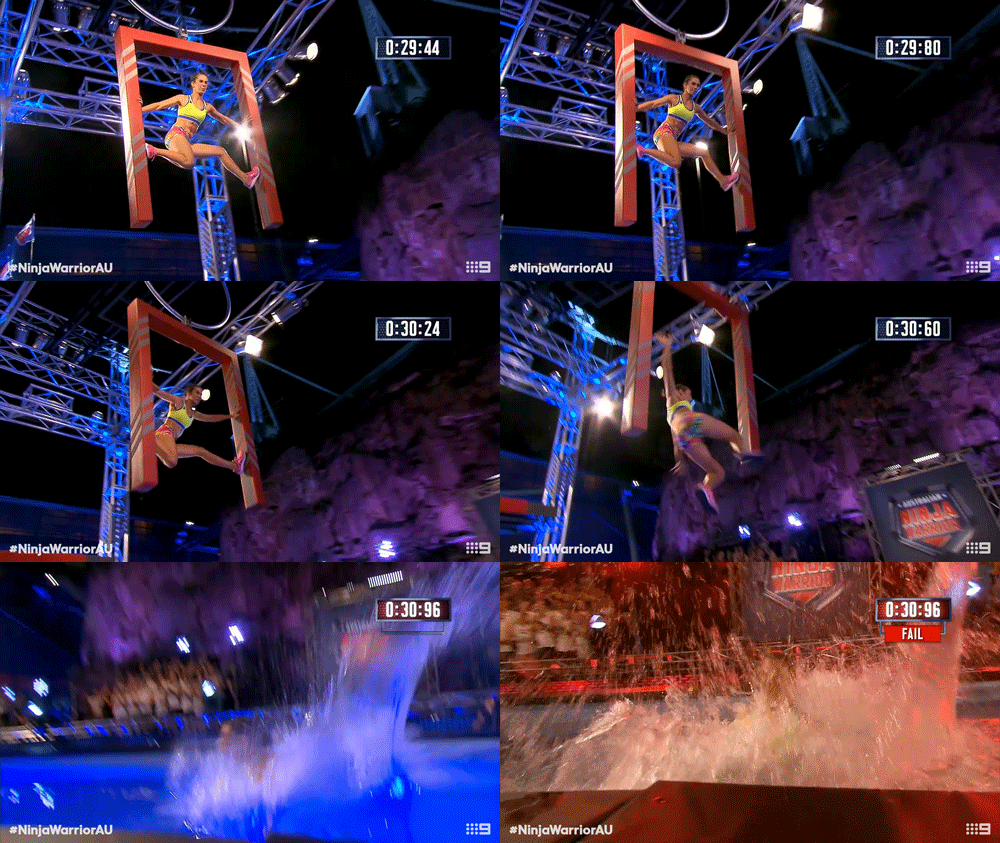
Your best isn’t perfect. You’re allowed to be both a masterpiece and a work in progress simultaneously. The key is “work in progress”. This means constantly seeking to grow and challenge your comfort zone. I recently started stretching this blog by connecting with others and expanding my interview outreach. On a personal level, I’ve committed to embark on Ninja Warrior despite having a premonition of:
4. Search for a best friend and ally
If there was an endgame in love, it’d be to find someone who loves you for you. Strive to nurture a love where you are both each other’s biggest fans and allies. You want to be your best and attract the best. Life isn’t set in stone, and nor is love. Find someone who’s enough and you’re enough for, and you’ll never need to compare yourself. Seek to be better than your past, not anyone else.
5. The new era of utility and sensation
For 99% of our 200,000 years of modern existence, human relationships served an economic, social, and biological purpose. Today, love has both a transactional and emotional purpose. We expect our loved one to fulfil an entire spectrum of needs that were previously satisfied by a tribe of people.
Conversely, the rise of social media means we no longer compare ourselves to the Joneses, but to the random Ukrainian model on Instagram. This has presented many of us with the paradox of choice, where the need for instant gratification and validation is now easily obtained with a swipe, like, or sext.
Finding the sweet spot of love’s utility and sensation becomes the foundation of a lasting relationship. Both practicality and emotion must exist to ensure we’re with someone for the right reasons, but also that we’re compatible. There’s a big difference between love that flows authentically between two people and one that is flat and only serves a purpose — whether physical or emotional.
6. Size does matter…
That is the size of someone’s investment and effort.
Investment is the key to balancing love’s need for utility and sensation. But not just any investment. Putting effort into someone should be based on reciprocity.
The amount of effort you expend on someone should be measured by how much effort someone spends on you. Loving someone means you make them feel safe, appreciated, and have no doubts about what you feel towards them. Human tendency is to act within the parameters we’re set. By setting up an environment where you are under appreciated, you will be unappreciated.
(…but it’s also what you do with it.)
7. Earned value = perceived value
People value what they have earned, especially when it comes to your time, emotion, and physical effort. Unconsciously, your partner will appreciate your investment less in they haven’t felt like they’ve done anything to deserve it.
The psychology of earned value is that someone will perceive something more valuable if they worked for it, as opposed to getting something handed for free. If you put your best effort into a competition and was awarded a certificate of participation, you’ll likely treasure it more than if someone handed you the winning trophy from doing nothing. In love, you are that trophy.
This isn’t about playing hard to get either. Instead, it’s about allowing someone to acknowledge your worth as something they both need and want in their life.
8. The foreplay of high standards
At a certain age, women, in particular, are told not to be “too picky”. Contrary to what we believe, attractiveness increases by maintaining high standards that align with our values. Certainty is sexy. Knowing what you want and sticking by it is even more attractive.
For most people, the fear of losing someone means their standards go out the door. Look to enforce the standards you believe in. This doesn’t mean that we should never compromise, but we decide what we want to compromise on.
Stephen Covey, in his acclaimed 7 Habits of Highly Effective People noted this as ‘win-win’. Win-win means holding onto your core values and beliefs whilst working with someone else’s. An ex once wisely said to me, “Never do what you don’t want to do. And if you do something you don’t want to, it’s because you choose to do it for someone else.”
Being in a loving relationship starts with the values you uphold long before it is about finding a compatible partner.
9. The (un)sexy relationship funnel
As sales marketing funnels are the relationship between a product or brand and a customer, intimate relationships work through a similar (un)sexy funnel:
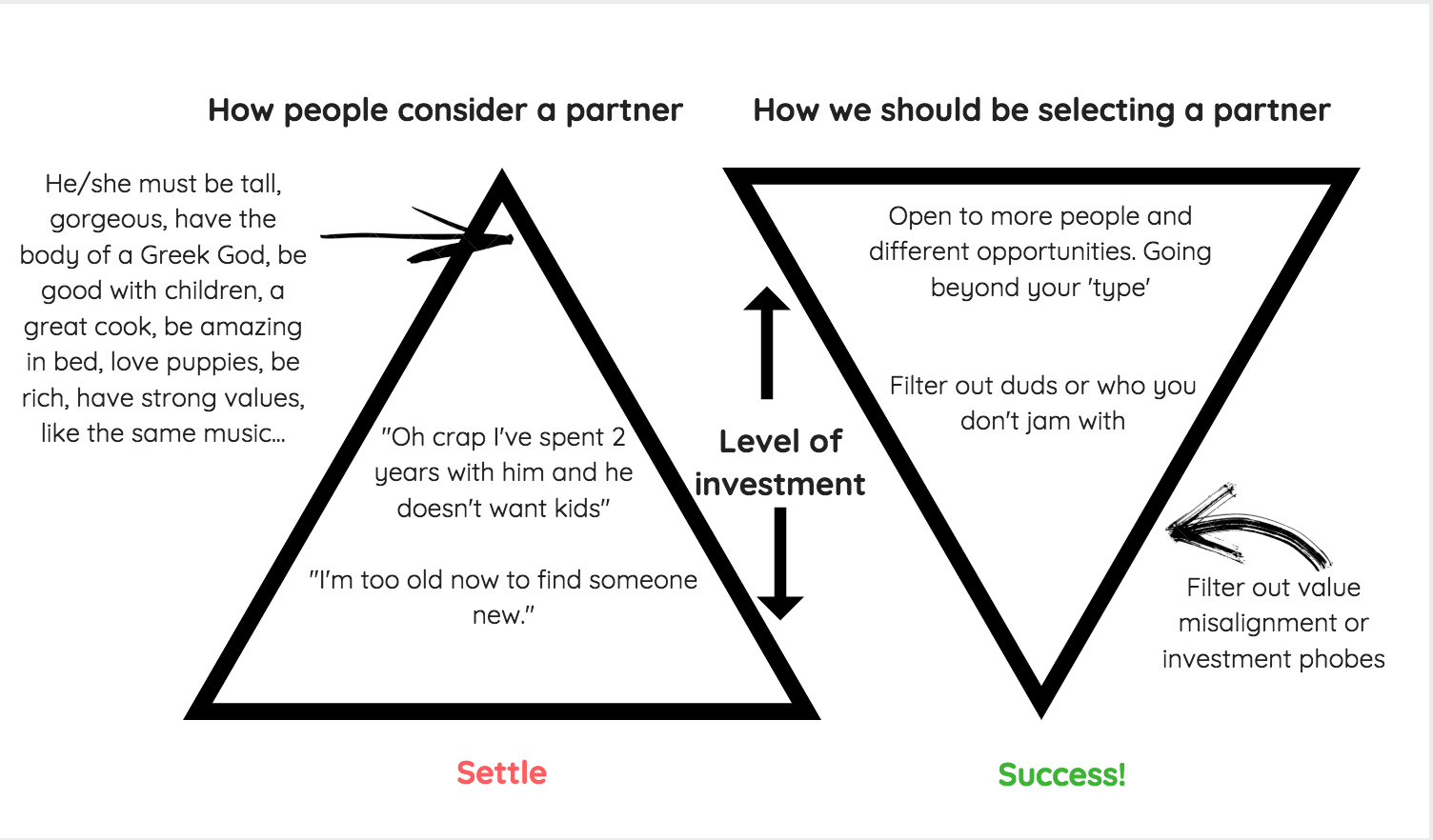
Failed relationships are often a result of inverted funnels. People are most selective when they’re getting to know someone when they should be open to different opportunities and people.
This is all dandy until you’ve decided someone is the ‘one’ and progress through the relationship. As more red flags get raised, it becomes too hard and you settle due to the effort justification effect. Adorning rose coloured glasses, you continue to entertain a relationship based on the amount of time and effort you’ve invested, despite the other person not being right for you.
Recall, emotional energy should be a positive correlation to a partner’s reciprocity and compatibility (lesson #6).
10. The code of attraction
Oscar Wilde famously said, “Success is a science. If you have the right conditions, you get the right results.” The science of attraction involves possessing the following qualities:
- Having self-confidence: certainty what you stand for and what you want.
- Exuding independence: Interests, hobbies, passions, and a purpose you adore. You love what you do.
- Maintaining integrity: You walk the walk and talk the talk. You don’t compromise what you believe in.
- Possessing self-awareness: Even with confidence, independence, and integrity, you’re not afraid to be human, to make mistakes, to learn, to be vulnerable, to need someone.
The conditions of attraction have less to do with what you do but are more aligned with who you are.
Why? Because attraction starts with you. On the outside, you could have all the surface confidence in the world and still not find love. Attraction stems deeper with surface qualities only encouraging the foundation for attraction. A lasting relationship has two people with all these elements, but also a tension that is created through desire.
11. Distance fosters desire
In early-day relationships, a proverbial straightjacket is needed to keep your hands off each other. As a relationship progresses, you move from lust and infatuation to connection, warmth, and love. Relationships struggle when desire and love don’t occur concurrently. In most cases, love replaces lust, as desire fades. Passion doesn’t need to wane with time though. The key to desirability is to create a magnetic pull of wanting something you don’t have. But how can you want something you already have?
Tension exists in the distance between two people. Psychology proposes numerous explanations around why we want what we don’t have. With love, an absence of someone’s presence or time apart creates feelings of longing and yearning. Distance provides the time to reflect and appreciate someone’s great qualities, recall positive memories, and remember the reasons why you fell in love with them in the first place. Yet the bedrock of a relationship can’t be founded on becoming a desire-recharging hermit every time the spark between two people gets dimmed. What you need is to always be creating that tension.
12. Always be flirting
Flirting isn’t just reserved for when you first catch someone’s attention, or when you go out on a date. As an enabler for micro-attraction, flirting is a result of a flow of tension and fun. Witty teasing and banter creates passion whether you’ve just spoken to someone for the first time or whether you’ve been together for 20 years.
Continuous flirting between yourself and a partner allows for a lively push and pull. It’s the space of knowing that you can’t guarantee that you’ll always completely have someone which keeps you on your toes. What keeps a relationship alive isn’t always grandiose gestures, but those little pockets of time where you are in the moment and having a laugh.
Your attraction to someone’s quirks, unique cues, or subtle nuances can always be desirable. The importance is whether you’re open to appreciate and act upon them. The dance of micro-attraction requires two people’s willingness to be on the same dance floor to begin with.
13. Truth is what you agree it to be
In 21 Lessons of the 21st Century, Yuval Noah Harari explains truth as “whatever Google tells you”.
In 21st Century love, truth, like trust, is defined by the agreement between everyone involved. While modern liberation has allowed us to freely express love in whatever form, a downside is that it leaves plenty of shades of grey. What constitutes infidelity? What is a committed relationship? Is it OK to want to chat with every hot guy that walks past while still loving your partner?
Defining the go and no-go agreements of your relationship keeps everyone safe and on the same page. Trust is like an emotional bank account that accrues interest based on another person’s investment and honesty to you.
14. Life repeats unlearned lessons
Like Christopher Nolan’s 2010 blockbuster hit Inception, you don’t have to fall into dreams for the same things to repeat themselves. If you’ve ever wondered why the same things keep happening to you, consider your behaviour and responses each time.
Life doesn’t always give you what you want, it gives you what you need. When I started paying attention and noticing my relationship patterns, I realised that the same things reoccurred because I didn’t learn what I needed to and change my response. A sure way to get the same outcome is to do the same thing. The result is I’ve reevaluated the way I invest in people and consequently seek to embody the lessons I’m sharing here.
15. Success in love is proportionate to the number of risks you’re willing to take
Crippling fear often holds us back from achieving our full potential. We don’t go up to the attractive man at the event, or speak to the woman we’ve locked eyes with at the coffee shop because our monkey brain is going haywire:
- “What if I get rejected?”
- “Being embarrassed will be awful”
- “What if I get embarrassed?”
- “It’s going to be so lame if I have to do the walk of shame back to my friend!”
These thoughts are daunting, but the question you should be really asking yourself is, “Would I regret this moment later if I didn’t do anything now?”
More often than not, my answer to the latter question is “Yes.” When our physical time on this world is up, one of the biggest regrets won’t be the number of mistakes you’ve made or looking like a fool, but not doing something you truly wanted to.
Fear is the immediate pain we feel when doing something new or uncomfortable, whereas regret is a pain we feel later. What pain are you going to prioritise? The pain of regret is always greater than the pain of fear.
16. Life isn’t a race
By the end of 2018, I will have gone to four weddings, including one of my younger cousins. Two of my closest girlfriends recently also got engaged. While stoked and over the moon for them, a small part of me didn’t want to be ‘that’ friend — the friend at the table with an awkward odd number of people, or the cousin which every older aunt asks, “When are you next?”
As fleeting feelings of uncertainty run through me, I’m always reminded that having a life you adore naturally attracts the right person into your life. While finding the right person is about valuing your time — the scarcest resource above all else, I’ve begun to embrace every person’s individual circumstances is what makes us unique. Who I am right now allows me to nurture distinctive qualities not present in anyone else.
17. Hurt strengthens your capacity to love
It’s refreshing to meet someone who doesn’t wear their emotional baggage like loose clothing. “I’m the single mum”, or “I was cheated on”. What happens to you becomes a part of you, but it doesn’t need to define who you are.
Every interaction and moment we have with someone teaches us something. If an experience is good, great. If we go through a rough patch, it teaches us a valuable lesson on what to avoid or do differently. Being hurt isn’t a life-long scar that you have to bear. Demonstrating hurt shows your capacity to love, be vulnerable, and invest in someone. How you frame past experience always sets the tone for future relationships. You can choose to be the victim or to casually acknowledge that a situation has strengthened your character. I personally choose the latter.
18. Accept what you can influence and release what you can’t control
Consider how hard it is to change yourself and you’ll understand what little chance you have at trying to change others. — Jacob M Braude
We lose what we cling onto. If someone feels forced or pressured into something, they will inherently rebel. To be understood, you must first seek to understand.
By stepping into another person’s shoes, you’ll vocalise your desires and encourage positive behaviour from not only your but their point of view. Ultimately your actions shouldn’t be dependent upon someone meeting your expectations. Someone’s choice to act, just like your own should be from their own accord.
Acceptance of this love lesson gives you remarkable freedom and power. Every relationship will face numerous different challenges, however, the right relationship will feel easy. And when you’ve found it you’ll recognise it immediately.
19. What defines you is when things are at their worst
When things are going well in life, it’s easy to be your best self. What truly defines us as individuals and partners in a relationship is when things aren’t roses and butterflies.
Adversity can amplify our worst traits and can draw out the most negative behaviours. To act with reason over irrationality, The Power of Now author Eckhart Tolle recommends that we should ‘watch your emotions’. In a heightened state of stress, emotions can be both your best friend and your worst enemy.
- If you took emotion aside, what would your best self do?
- If a friend came to you with the same situation, what would you say to them?
- How can you respond with resilience, strength, and humility, instead of hurt, anger, and pain?
20. Embody what you want to manifest
We all have desired layers within partner — on a surface level, on a lifestyle level, and on a core values level. To attract what you want, you need to be what you want. When reviewing the traits and qualities you’re looking for in someone, assess what is truly valued, and what might be vanity or ‘nice to have’.
Of the qualities you’re looking for in the different areas of someone else’s life, how many of these characteristics do you possess yourself?
We naturally mirror and draw in what we are. By working on yourself, you not only increase your attractiveness (lesson #2), you also increase your compatibility with more people in your funnel (lesson #9) on a deeper level.
To get what you want, you need to be that person first.
21. The Future of Love
Disruptive technologies have always paved new systems for living. The technological age has dramatically shifted the way we live through Artificial Intelligence (AI) to exploring a whole new world with Mixed Realities.
The infiltration of technology hasn’t circumvented love either. Revolutionising the way we relate to ourselves and our partners, the booming SexTech industry is expected to be worth US $30 billion. Designed to stimulate, enhance, and assist with intimacy, SexTech is coming in all shapes and forms, from robots to vibrators and simulations. The Future of Love poses many exciting opportunities and experiences beyond what the mind can fathom. But one thing it doesn’t change is who we are.
Of the 21 lessons outlined, you may note that only one or two love lessons focus on technology because as much as technology or social media changes the landscape in which we love, the core principles of love don’t change. Technology is an enabler for us to be who we already are. As the world continues to move at an even faster rate, the fundamental traits of trust, respect, investment, and having high standards in love do not. Beyond our emotions, technology, or future predictions, everything about love boils down to one truth: love is something that we are.


